Caregiving 7 min read
AI Check-In Calls for Seniors: Daily Peace of Mind
A daily ring can confirm your parent picked up. Here is how those products work, what isolation data shows, and which caregiver phone jobs they leave untouched.
On this page
- 01
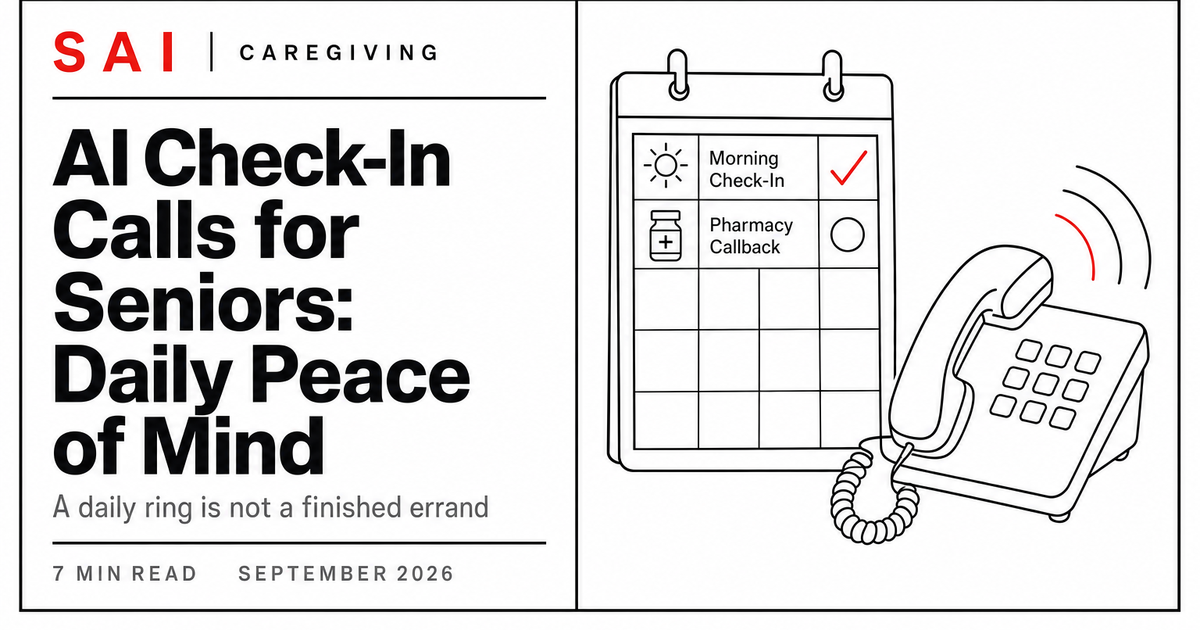
A check-in product is a scheduled call plus an alert, not a medical device or a house call.
- 02
Loneliness and isolation still affect roughly one-third of older U.S. adults, which is why families pay for a daily ring.
- 03
Check-ins do not book appointments, sit on hold, or settle billing fights.
- 04
SAI is an iPhone app for those leftover phone errands, at $19.99 a month or $149.99 a year for 15 errands, and no AI caller finishes every call.
What ai check in calls for seniors actually involve
If you are weighing ai check in calls for seniors, the product is a scheduled voice call that checks whether a parent answered and sounded like themselves, then alerts you if the call is missed or the conversation raises a flag — that is the job ai check in calls for seniors are sold to do.
The call itself is the unit of work: a number is dialed at a set time, someone talks, and a family member gets a yes, a no-answer, or a short note. No extra gadget is required if the service places an ordinary inbound call.
The most fully described public program is overseas. The New York Times reported in April 2026 that South Korea’s Talking Buddy initiative, developed by Naver Cloud, regularly checks on tens of thousands of seniors living alone. According to that report, the calls typically last two to five minutes and are designed to reduce loneliness, identify emergencies, and stimulate cognitive function.
U.S. consumer versions follow the same outline — a weekday or daily slot, a missed-call text to an adult child, sometimes a written summary. They are not medical devices and they are not a substitute for a person with a spare key. They also assume the parent will pick up an unknown or unfamiliar caller ID, which some people never do.
Why a daily call became a product
Families pay for a daily call because loneliness and isolation among older adults are common, costly, and easy to miss from another city. A parent can look fine in a weekly photo and still go days without a real conversation.
Centers for Disease Control and Prevention (CDC) data last updated November 3, 2025 show that more than 1 in 3 adults aged 45 and older in the United States report feeling lonely, and nearly 1 in 4 adults aged 65 and older are socially isolated. The same CDC estimates put the economic cost of loneliness among U.S. adults at $406 billion per year, including about $6.7 billion per year in additional Medicare costs attributable to socially isolated older adults.
A 2025 JAMA (Journal of the American Medical Association) study of U.S. adults aged 65 and older found that 37.2% reported loneliness in 2023 and 33.4% reported loneliness in 2024. In the same analysis, the share reporting social isolation was 33.7% in 2023 and 29.2% in 2024, meaning close to one-third of U.S. seniors were socially isolated even as pandemic-era restrictions eased.
Isolation is not only a feeling. Centers for Disease Control and Prevention (CDC) notes that social isolation is linked to approximately a 50% increased risk of dementia and about a 29% increased risk of heart disease in older adults. A separate Centers for Disease Control and Prevention (CDC) overview states that social isolation among older adults is associated with higher risks of depression, anxiety, and premature death.
That is the gap a short daily call is trying to close: not treatment, just a regular human sound and a chance to notice when it stops.
Frequently asked
Not always, if the service places an ordinary inbound call to a landline. You can still receive the missed-call alert on your own phone. Pew Research Center reported on January 8, 2026 that 78% of U.S. adults aged 65 and older own a smartphone, so most parents can take a mobile call, but the remaining share still cannot.
No. A check-in is a wellness call, not a billed office visit. The Centers for Medicare & Medicaid Services (CMS) Medicare Telehealth Trends Report released in late 2023 describes telehealth office visits as requiring real-time audio and/or video communication with patients, and audio-only telephone visits are part of that framework when they meet synchronous communication requirements.
That is common enough to plan for. Pew Research Center’s 2024 internet and broadband fact sheet shows that by June 10, 2024, 77% of adults aged 65 and older used the internet, and 14% of people 65+ were smartphone-only internet users with no home broadband. A voice call still works; an app-only product may not.
Comfort is rising, not universal. According to a Pew Research Center analysis of older adults and technology published July 17, 2023, about 67% of Americans aged 65 and older get news on a mobile device, a 24-percentage-point increase over the previous year. A check-in that uses a regular inbound call still asks less of them than a new app.
What a check-in call cannot do
A check-in call cannot finish the outbound phone work caregiving creates, and it is not an emergency service, a nurse, or a locksmith.
If the parent does not answer, the service can text you. It cannot decide whether to drive over, call a neighbor, or wait until lunch. A confused-sounding voice still needs a person who knows that parent. Billing fights and insurance appeals are jobs for a person, not a two-minute hello.
They also do not book, move, or cancel the appointments that pile up around aging. A two-minute wellness chat will not press 2 for pharmacy, wait out hold music, or work down a list of dental offices until one has a Thursday slot. Families who want a fuller picture of AI around aging can start with How Families Are Using AI in Elderly Care Today, which sits next to this narrower product.
One more gap: the parent has to take the call. An unfamiliar caller ID, a thick accent from a synthetic voice, or a person who simply hates the phone will produce a string of missed check-ins that look like emergencies and are not. No AI caller finishes every call. Treat a missed ring as information, not a diagnosis.
The phone errands a check-in never finishes
The leftover work is calling businesses until an appointment, a refill, or a cancellation is actually done, and that is a different product than a wellness check.
That is the job SAI for caregivers is built for. SAI is an iPhone app that places real telephone calls until the errand is finished. You type or speak one sentence — ask the pharmacy if a refill is ready, book a dentist this week, cancel a gym membership — and SAI dials, presses through the phone menu, waits on hold, and talks to whoever answers. An errand is an outcome, not a call: six attempts to finish one refill still count as one errand. The number is never invented; it comes from you or from a listing you approved.
When a call ends one detail short, SAI does not guess and it does not redial on its own. It asks you the missing question in the app, then places the next call only after you answer. No audio is kept; you get a plain-sentence outcome and a transcript. It never calls emergency numbers. Agreed appointments land on the calendar. Pricing is $19.99 a month or $149.99 a year for 15 errands a month, with a 3-day free trial that includes 3 errands. Unused errands do not roll over. Billing runs through the App Store.
Limits are real. Some lines go unanswered. Occasionally a business will not deal with an assistant. SAI has not run any formal published benchmark. For caregiver apps beyond the phone, see Best Apps for Family Caregivers: What Actually Helps. For live-call tools, see Best AI Phone Call Apps: Which Ones Handle Real Calls?.
Let SAI handle this errand.
When the leftover work is a pharmacy, a dentist, or a cancellation, type the sentence and SAI places the calls.
Try SAI free