Guide 6 min read
The Best Medication Reminder Apps, Tested With Real Seniors
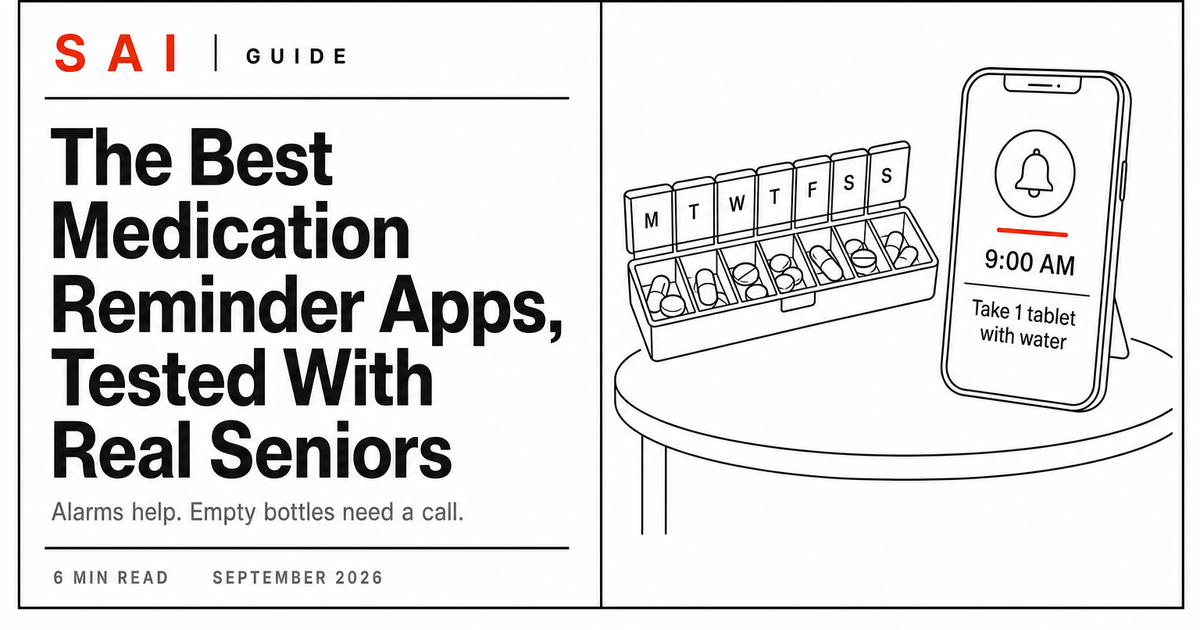
Most people over 65 already take prescriptions and already own a smartphone. The useful question is which reminder they will still tap — and what to do when the bottle runs out.
On this page
- 01
Most older adults already take prescriptions and already own a smartphone; the real test is whether they will keep using the reminder.
- 02
Published trials show modest gains in self-reported adherence, not a reliable change in clinical measures such as blood pressure.
- 03
Cost and empty bottles still stop doses; a chime cannot refill a prescription.
- 04
Use a simple reminder for the daily dose, and a real phone call for the pharmacy and the clinic.
The best medication reminder apps still have to survive real daily use
The best medication reminder apps earn that label only if an older adult will still tap them after the novelty wears off, which is a harder test than any store ranking.
Hardware is no longer the main barrier. A Pew Research Center (Internet use, smartphone ownership, and digital divides in the U.S., 2026) analysis of 2025 survey data found that 78% of Americans ages 65 and older own a smartphone. The Pew Research Center (Mobile Fact Sheet, survey Feb. 5–June 18, 2025) reports 90% ownership among adults 50 to 64. A 2024 report from the Centers for Disease Control and Prevention (National Health Statistics Reports No. 209, 2024) found that in 2021–2022, 88.6% of older adults took prescription medication. Most people in this age group both take pills and carry a phone.
Usability data in older adults is still thin. In a feasibility study among rural older adults, 13 participants used Medisafe for daily medications, according to PubMed (Ease of Use and Usefulness of Medication Reminder Apps, rural older adults, 2019). Inspect the alert volume, the type size, and whether taken/skipped can be fat-fingered. An app that needs a weekly tutorial will lose to a kitchen timer.
What the trials actually show about adherence
Reminder apps can raise self-reported adherence by a modest amount; they have not been shown to change clinical measures such as blood pressure.
In a 2021 review and quality analysis, MyTherapy received the highest global quality score of 3.79 out of 5 (interquartile range 3–4), followed by Medisafe at 3.72 out of 5 (IQR 3–4), per PubMed (mobile applications to improve drug adherence: review and quality analysis, 2021). Those scores rate the software, not swallowed pills.
The MedISAFE-BP trial enrolled 413 patients with poorly controlled hypertension, randomized 1:1 to usual care or Medisafe, with 12 weeks of follow-up, per PubMed (Rationale and design of the MedISAFE‑BP trial, 2017). Use of the app produced a small improvement in self-reported adherence but no significant change in systolic blood pressure, according to PubMed (The MedISAFE‑BP Randomized Clinical Trial, JAMA Internal Medicine, 2018).
A 2025 study of Medisafe in 100 patients with breast cancer on oral medication found that 78% completed 12 weeks; among those nonadherent at baseline, 26.3% reported adherence after, per PubMed (Use of a Smartphone Application to Promote Adherence to Oral Medications in Patients With Breast Cancer, 2025). Use the alarm. Do not treat it as treatment.
Frequently asked
When the person crosses time zones, a clock-tied reminder can fire at 3 a.m. local time. Open the app on arrival and confirm each dose is anchored to local time, not to the home clock. If that setting is buried, fall back to a one-day paper list until you are sure the alerts moved.
Yes, at the next visit. Bring a screenshot of the dose schedule so the list can be checked against the chart. Pharmacists can catch duplicates that an app will faithfully remind someone to take. The app does not replace a medication review, especially after a hospital discharge when the list often changes overnight.
Then skip the app. A labeled weekly pillbox, a landline call from a family member, or a pharmacy blister pack will beat a tool they cannot launch. Do not buy them a smartphone just for reminders; unused devices become another unpaid job for the caregiver. Match the cue to the device they already use every morning.
iPhone Focus modes and Android Do Not Disturb can swallow a reminder whole. Allow the app through Focus, or the 8 p.m. statin alert never rings. Test this on night one: enable the person's usual bedtime silence, then trigger a dummy dose. If the phone stays quiet, fix the exception before you rely on it.
When the alarm is not the problem
Cost, empty bottles, and unanswered pharmacy lines still stop doses even when the reminder fires on time.
The same CDC report measured cost-related nonadherence. In 2021–2022, 3.4% of older adults did not take medication as prescribed because of cost, 2.2% took less than prescribed, 2.7% delayed filling prescriptions, and 1.7% skipped doses because of cost, according to the Centers for Disease Control and Prevention (National Health Statistics Reports No. 209, 2024). An app can ping at 8 a.m. It cannot fill an empty bottle.
The next failure is the hold queue. Refill status and prior authorizations are daytime calls. Adult children already live in that queue, which is why we keep a guide to the Best Apps for Family Caregivers: What Actually Helps. A reminder app tracks the dose; it does not dial the pharmacy. For that chore, AI phone calls, explained here, are a different tool: type ask the pharmacy if mom's refill is ready, and a real call goes out. SAI, the iPhone app behind this site, keeps a summary and a transcript, never audio, and never redials on its own. An errand is an outcome, not a call. No AI caller finishes every call. The report should say what happened.
How to choose without a fake shortlist
Choose a reminder app for the daily dose, and keep a way to reach the pharmacy, the clinic, and the insurer when the dose is not the problem.
Start with the person, not the store ranking. If an iPhone Clock alarm already works, you may not need another app. If they take several medicines at several times, you do. Look for one screen of today's doses, a unique sound, a large taken/skipped control, and — if you need it — a ping to family when a dose is skipped. Confirm that last setting before you depend on it. Sit through the first setup together.
Leave the app when the task is a conversation. Checking a refill or moving a clinic visit is a phone errand; most assistants write a script and stop. SAI places the call, waits the hold, and returns the outcome; an agreed appointment can land on the calendar. It costs $19.99 a month or $149.99 a year for 15 errands, and several attempts still count as one. Families using AI around aging parents will recognize the split, which we cover in How Families Are Using AI in Elderly Care Today. An insurance appeal still belongs to a person.
Let SAI make this call.
If the bottle is empty, type the pharmacy question and SAI will place the call and bring back what happened.
Try SAI free